

CLT Testing & the Service Academies

A new testing alternative beyond the SAT and the ACT for candidates
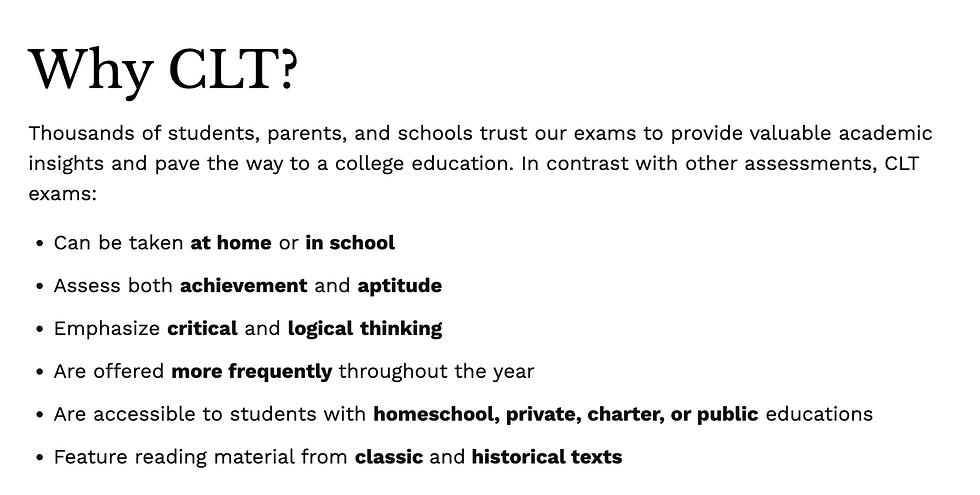
The US service academies will start accepting the Classic Learning Test (CLT) this year beginning February/March 2026. In theory, that means a student may 'skip' taking the SAT or ACT.
The CLT has a number of advantages according to the the official CLT website. It may be taken at home, remotely, and there is no added costs for official scores to be transmitted to different institutions, like the Naval Academy or Air Force Academy. But let's explore some details.
The Classic Learning Test was introduced a decade ago by the for-profit company Classic Learning Initiatives. It assesses high schoolers’ verbal reasoning, grammar and writing, and math skills, similar to the SAT or ACT. But unlike the other tests, the CLT draws its reading-comprehension passages exclusively from “classic” works, which is a difference the CLT organization claims provides “an invaluable opportunity to engage students with the texts and authors that have shaped history and culture.”
The CLT exam is intended for 11th and 12th graders. It takes about two hours to complete. Students take the test online. Typically, it is taken remotely from home, but partner colleges, universities, and some testing centers host in-person options. Locations varying by institution and region so a student will need to check the official CLT website or the college's testing center for details.
CLT scoring combines three 40-point sections (Verbal Reasoning, Grammar/Writing, Quantitative Reasoning) into a total score from 0-120. Questions and their correct answers are scaled by difficulty. An overall score above 70 is considered average and 114+ nears a perfect SAT/ACT equivalent (according to sources).
CLT reading, like the SAT or ACT college-entrance exams, employs individual passages and comprehension questions. The main difference with the SAT/ACT is the reading passages themselves. The CLT draws its text from authors whom its test creators have deemed “shaped history and culture.” These passages tend to be longer than those in the SAT or ACT.
The CLT math section tests algebra, geometry, and mathematical reasoning and does not allow a calculator. The SAT and ACT, by comparison, both include statistics in their math sections, and allow calculators for a portion of or the entire test.
Many of the over 300 partner colleges (like those listed on the CLT website) offer in-person testing for their students and sometimes the public, with sites in states from California to New York. Some community colleges (like College of Lake County in Illinois or Craven Community College in North Carolina) have dedicated centers for various tests, including CLT-related ones. For more details go to cltexam.com to find details on test dates and locations.
So, what does this change mean for a candidate for the US service academies? Let's discuss . . .
1) The CLT is another option. I find that some students prefer the ACT over the SAT and the reverse. Thus, students may simply find they prefer the CLT over the other two standardized tests.
The one big issue is making a comparison. Although the CLT notes its average score as 70 points, I caution making assumptions for the service academies (SAs) and the standards they will accept. The average scores for incoming cadets and midshipmen on the ACT and SAT are in the top 10% of scores in the country. Thus, using this guidance, I would recommend shooting for the same on the CLT, which is a 94 or higher. However, with no track record with the CLT, the SAs will likely be cautious.
2) The CLT offers more flexibility. Neither the SAT or ACT allow remote testing. Consequently, there should be no reason why you cannot take a CLT. In fact, if you are feeling under the weather, being at home makes this testing option more palatable for you. The only caution is you must stay on camera during the test for video monitoring.
Another nice feature is that there is a January test. Thus, a high school senior has the option to take the CLT prior to the service academies' deadlines of January 31. The last dates for the ACT and SAT are in December. That option may prove helpful for some students.
Also, after the initial fee (as I noted previously), the CLT will not charge you a fee to send scores electronically to different institutions. Sadly, the ACT and SAT charge for this additional service.
3) The CLT is an unknown commodity! The SAs did not choose to use this test. Each one was forced to add it. Multiple states have looked at the CLT and chose not to use it for their college and university acceptance standards. Plus, it is only accepted at a narrow set of civilian schools. Keep all of these facts in mind as you plan for testing with the ACT, SAT and/or CLT.
With these three points in mind, here's what I recommend:
Take the ACT or SAT first. They are 'tried and true' so the SAs are comfortable awarding appointments to students with strong to average scores. If you find your ACT and SAT test scores are not as strong as you desire, then take the CLT.
Take at least one CLT as a 'trial balloon.' I recommend the same for the SAT and the ACT. It should help you identify which one you prefer. Early in your junior year, or at the end of your sophomore year, is a good starting point.
Do not rely solely on the CLT. Without an admissions history with the CLT, the SAs will be hesitant to use the test results until they understand their utility. It may work out for you, but with the ease of taking alternate tests, having other results will give the SAs more confidence. Plus, at this point in time, it is unclear that the SAs will superscore the CLT.
Bottomline: there is nothing wrong with using the CLT if you find it is your best alternative and best test scores. However, until more it known, plan on taking the ACT or SAT as your initial testing options. Use your results to determine if the CLT makes sense for you.
[I would also welcome an opportunity to speak to you about a coaching engagement — I provide active consultation on the entire admissions process, including preparation and review for interviews, essays (personal statements), activities and more for all five of the U.S. service academies: USAFA, USMA, USMMA, USCGA and USNA; plus, I work with students to purse ROTC scholarships for the Army, Air Force and Navy. Call me at (503) 515-7406, email me at chris@cbbrechin.com or use my contact form on this website.]


Comments